- Location : Home» Newsroom
Global Warming Raises Heat Risk to Yield and Fibre Quality in Xinjiang During the Flowering and Boll Stage
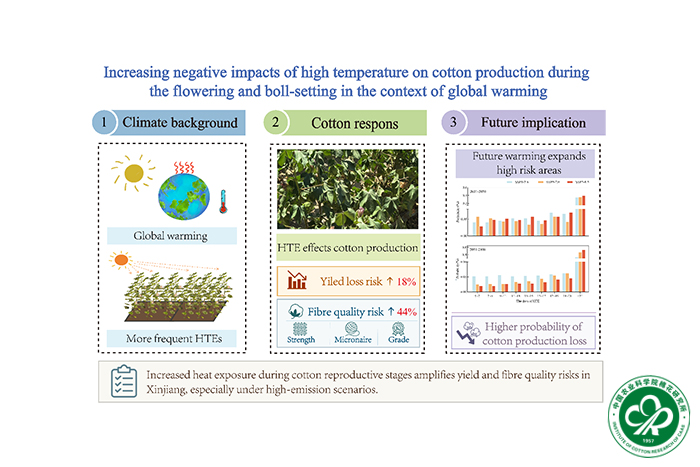
Global warming has increased the frequency of extreme high-temperature events worldwide. The flowering and boll-setting stage of cotton is critical for yield formation and fiber quality development, and cotton is particularly susceptible to heat stress at this stage. Nevertheless, the integrated effects of high-temperature exposure on cotton yield and fiber quality, as well as their regional heterogeneity, remain insufficiently quantified. In this study, we compiled cotton yield records from 73 cotton-growing counties, meteorological observations from 42 weather stations for 1990–2022, and fiber quality datasets from 843 monitoring sites across Xinjiang during 2016–2022. Using the Copula model, we systematically quantified the responses of cotton yield and fiber quality to high-temperature exposure during the flowering and boll-setting period. Combined with nine CMIP6 global climate models under the SSP1-2.6, SSP2-4.5 and SSP5-8.5 scenarios, we further projected the potential risks to cotton production under future climate change. Our results revealed divergent responses of cotton yield and fiber quality to heat exposure. High temperature exerted stronger adverse impacts on yield than on fiber quality, and such impacts exhibited pronounced spatial disparities across Xinjiang cotton zones. The risk of heat-induced yield loss is projected to escalate continuously with rising global temperature. This study provides quantitative evidence for understanding heat risk of Xinjiang cotton and offers scientific support for developing climate-adaptive cotton planting strategies, heat-tolerant cultivar deployment and regional layout optimization under global warming.