- Location : Home» Newsroom
The GhOFP1-GhTALE-GhXTHB transcriptional cascade regulates vascular cambium development in cotton stems
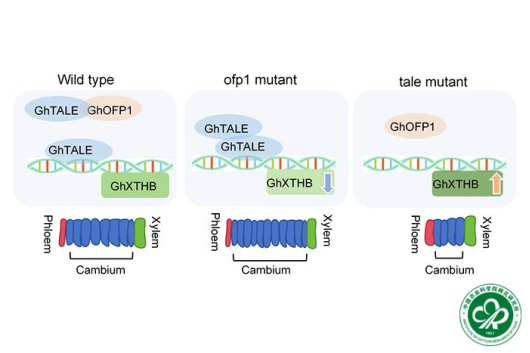
The temporally regulated morphogenesis of plant organs depends on the precise differentiation of meristematic stem cells. This process is driven by the coordinated dynamics of specific stem cell populations in apical and lateral meristems, which mediate longitudinal elongation and radial thickening, respectively. Although considerable progress has been made in elucidating apical meristem-mediated longitudinal growth, the spatiotemporal mechanisms governing radial growth through the vascular cambium remain incompletely understood. Here, we generated high-resolution single-cell transcriptomic profiles of stem tissues from the cotton cultivar ZM24. Gene regulatory network analysis identified GhXTHB, which was highly expressed in the vascular cambium. Overexpression (OE) of GhXTHB reduced the number of vascular cambial cell layers and xylem width compared with the wild type, whereas CRISPR-Cas9-mediated knockout (KO) of GhXTHB increased the number of cambium cell layers without affecting xylem width. We further identified GhTALE as an upstream regulator of GhXTHB; OE of GhTALE promoted cambium cell proliferation and increased the number of cambial layers. By contrast, knockout of GhTALE (KO-GhTALE) reduced both cambial proliferation and xylem width. Notably, GhXTHB expression was upregulated in GhTALE-edited lines, indicating that GhTALE negatively regulates GhXTHB. Further analysis revealed that GhTALE physically interacts with GhOFP1, and KO of GhOFP1 increased the number of vascular cambium cell layers. Mechanistically, GhOFP1 is recruited to the GhXTHB promoter through its interaction with GhTALE, thereby modulating vascular cambium development. These findings identify the GhOFP1-GhTALE-GhXTHB module as a regulatory cascade controlling vascular cambium proliferation in cotton stems, providing new insights into the transcriptional control of stem architecture and biomass accumulation.