- Location : Home» Newsroom
Breeding High-Yield Cotton on Saline Lands of Southern Xinjiang
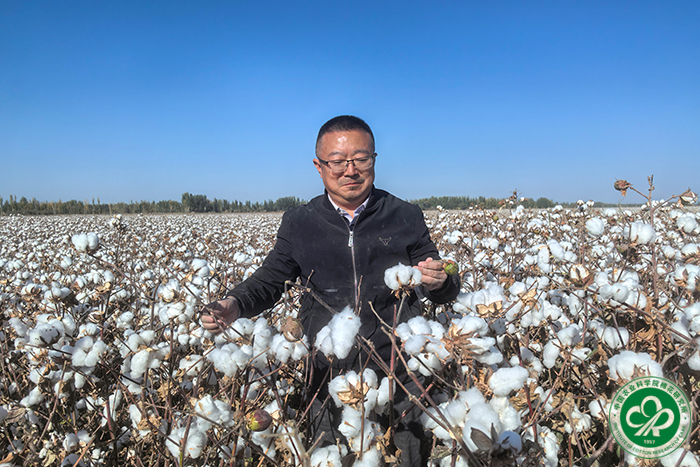
Researcher Yuan Youlu of the Institute of Cotton Research of CAAS has devoted over 30 years to cotton genetic breeding. Since 2019, he has been stationed in southern Xinjiang, applying molecular breeding to tackle salinity barriers. With elite seeds, he has turned saline wasteland into productive fields with stable yields and higher farm income. His team runs trial sites across Kashgar, Jiashi, Makit, Yopurga and Bachu, fulfilling the mission of invigorating agriculture through science and technology.
Salinity is a major bottleneck for cotton production in southern Xinjiang. More than half of arable land in Kashgar suffers from salinization, with high salt and drought hampering emergence and yield gains. Yuan’s team built an integrated breeding pipeline combining conventional breeding, marker-assisted selection and stress screening, breaking the trade-off between salt tolerance, yield and fiber quality. After multi-site trials, they developed the nationally approved variety CMB908. Adapted to early-medium maturing cotton zones in the northwest inland, it has a growing period of 125 days, boll weight of 5.9 g, lint percentage of 43.6%, upper half mean length of 29.8 mm, breaking tenacity of 31.1 cN/tex and micronaire value of 4.9. Featuring high yield, good fiber quality, disease and insect resistance and salt tolerance, it suits full mechanized harvesting and offers key support for cotton planting on saline land.
Elite varieties deliver value only when deployed in farmers’ fields. In 2025, a 260‑mu demonstration plot in Bachu reached 573.3 kg seed cotton per mu, 12.42% higher than local mainstream varieties. Notably, CMB908 grown on saline land in Makit recorded fiber sugar content as low as 0.71%, solving the long-standing problem of sticky cotton that impairs spinning. The variety licensing deal between ICR‑CAAS and Xinjiang Zhongmian Seed Co., Ltd. was signed the same year. Through the National Cotton Industry Alliance, the team promoted large-scale contracted cotton production. Textile mills paid an extra 0.6 yuan per kg for its premium seed cotton, raising farmers’ income by about 300 yuan per mu and sharing technological dividends with growers.
Yuan and his team stay on-site year-round, designing customized packages for irrigation, fertilization and plant growth regulation for saline plots and delivering hands-on training. As Party branch secretary, he integrates Party building with research and encourages team members to prioritize original breeding innovation and connect with local farmers, enterprises and authorities. Guided by the ICR‑CAAS Spirit, many team members spend over 150 days each year in Xinjiang. They have run 30 training sessions for more than 1,500 growers across major cotton counties, providing steady technical support for rural revitalization.
Thirty years in breeding, six years rooted in southern Xinjiang. Yuan and his team keep improving salt-tolerant, high-yield and multi-resistant cotton lines and matching cultivation techniques. Their work boosts agricultural efficiency and farmers’ income and safeguards national cotton supply security.