- Location : Home» Newsroom
Organic amendment effects on soil properties and crop yield in cotton field: A meta-analysis
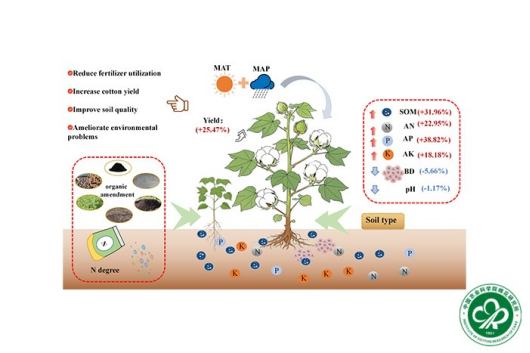
China is the world's largest cotton producer; however, its excessive nitrogen fertilizer application has led to serious environmental issues. Substituting part of synthetic nitrogen fertilizer with organic amendment is regarded as an effective approach to achieving zero growth in chemical fertilizer use while maintaining or increasing cotton yield. In this study, a meta-analysis was used to evaluate the effects of different organic amendment on cotton yield and soil properties. A total of 56 peer-reviewed studies conducted in China between 2000 and 2024 were systematically collected, yielding 412 paired observations for quantitative synthesis. The results showed that organic amendment on average increased cotton yield, soil organic matter (SOM), available nitrogen (AN), available phosphorus (AP), and available potassium (AK) by 25.47%, 22.95%, 31.96%, 38.82% and 18.18%, respectively, while soil pH and bulk density (BD) decreased by 1.17% and 5.66%, respectively. For cotton yield, the main influencing factors were nitrogen fertilizer rate, soil type, organic amendment type and application rate, return duration, mean annual precipitation (MAP), and mean annual temperature (MAT), with contribution rates of 24.7%, 24.4%, 27.4%, 25.5%, 21.5%, 27.0% and 27.3%, respectively. Similar patterns were observed for physicochemical properties. For example, the responses of SOM, AP and AK were not significant when nitrogen applications rates were below 100 kg ha −1 , whereas organic amendment showed no significant effects on soil AN and AP at soil depths 40–60 cm. For soil pH and BD, most influence factors exerted significantly negative impacts, which soil type and organic amendment type being the dominant drivers, respectively. Regression analysis revealed significant positive correlations between cotton yield, soil AN, and nitrogen application rate, whereas a significant positive correlation was observed between cotton yield and MAP. Furthermore, random forest analysis identified nitrogen fertilizer rate, MAP, and MAT as the most important predictors of cotton yield and soil physiochemical properties in China. In conclusion, the rational integration of organic amendment with inorganic fertilization represents a feasible and effective strategy for enhancing cotton productivity and improving soil fertility in China.