- Location : Home» Newsroom
GhIMP10D, an inositol monophosphatase gene enhancing alkaline stress tolerance in plants
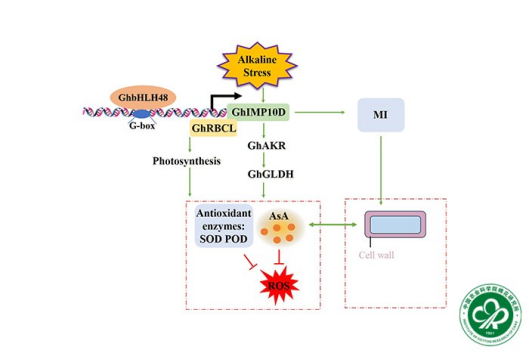
Introduction Soil salinization and alkalization are major challenges to global agricultural productivity and food security. Ascorbic acid (AsA) is an essential antioxidant that helps plants mitigate various abiotic stresses. However, the genetic mechanisms underlying AsA's role in enhancing alkaline stress tolerance remain poorly understood. Objectives The objective of this study was to determine whether GhIMP10D, a gene involved in AsA biosynthesis, enhances alkaline stress tolerance in cotton and Arabidopsis by modulating AsA accumulation and cell wall integrity. Methods We performed gene identification and functional analysis using overexpression and silencing techniques in Arabidopsis, rice, and cotton. GhIMP10D, a gene involved in the AsA biosynthesis pathway, was studied for its response to alkaline stress. The role of the bHLH transcription factor GhbHLH48 in regulating GhIMP10D was also explored. Results Our findings showed that overexpression of GhIMP10D resulted in increased AsA production, reduced reactive oxygen species (ROS), and enhanced cell wall integrity in the tested plants. In contrast, silencing GhIMP10D compromised alkaline stress adaptation. We further identified that GhbHLH48 directly activates GhIMP10D by binding to its promoter's G-box element. Manipulating GhbHLH48 levels altered AsA, lignin, and cellulose content, which affected ROS balance and cell wall biosynthesis. Conclusion The GhbHLH48-GhIMP10D regulatory module plays a crucial role in AsA biosynthesis and the maintenance of cell wall integrity under alkaline stress. These findings contribute to a better understanding of AsA signaling pathways and cell wall formation in response to alkaline stress, offering potential strategies for enhancing plant stress tolerance.