- Location : Home» Newsroom
Party Representative at the Frontline | Wang Ning, Researcher of ICR‑CAAS: Building Dreams for Cotton Fields with Fine Seeds
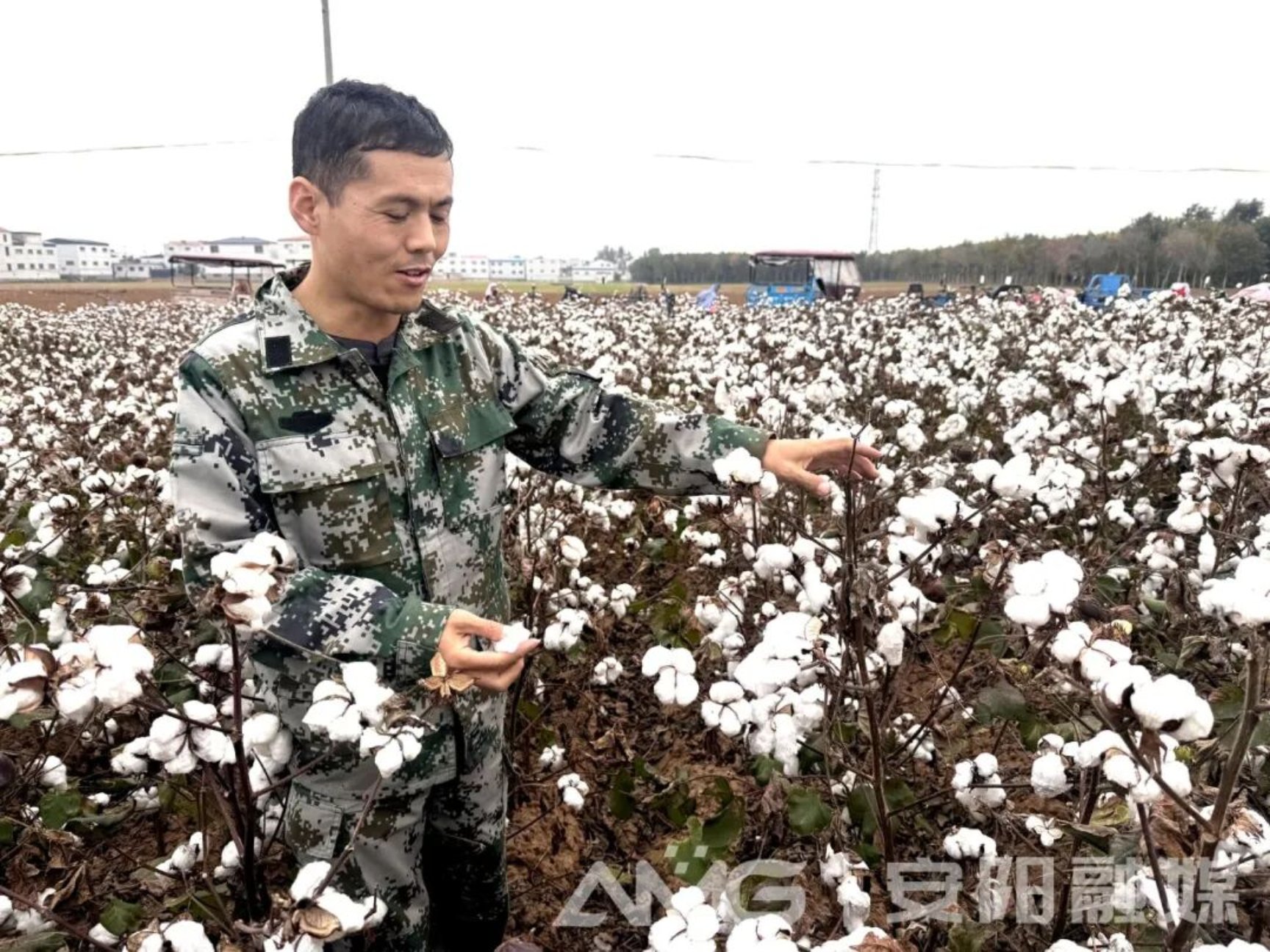
In the golden autumn, the trial fields of the Institute of Cotton Research of CAAS (ICR‑CAAS) in Baibi Town, Anyang County are brimming with a bumper harvest. Hundreds of mu of cotton plants are laden with bursting bolls, their white lint stretching far like a blanket of snow. On October 28, our reporter found Wang Ning, researcher of ICR‑CAAS and delegate to the 12th Henan Provincial Congress of the Communist Party of China, bending among waist‑high cotton plants, carefully checking boll setting and opening and recording trial data.
Right after the provincial congress, Wang Ning headed straight back to the trial fields without pause. “This field is a cradle for breeding. Its variety CCRI 49 once underpinned half of the cotton planting in southern Xinjiang. Stable‑yielding and high‑quality, it won the Second Prize of the National Science and Technology Progress Award and is a time‑tested favorite among cotton farmers,” Wang Ning said enthusiastically.
“This is our newly bred variety CCRI 9001,” he said, plucking a boll and pulling out fluffy white lint with pride. “It is an all‑round upgrade of CCRI 49, with improved yield, stress resistance and fiber quality. It is the first cotton variety nationally approved for all three major cotton zones: the Yellow River Basin, the Northwest Inland and the Yangtze River Basin. It can reach up to 530 kg per mu on moderately to severely saline‑alkali land in Xinjiang, and maintains a stable yield of around 300 kg per mu in inland regions, showing outstanding adaptability.”
Such high‑yield elite varieties come from years of relentless field trials by Wang Ning and his team, backed by solid agricultural innovation. Having devoted 18 years to cotton research, Wang Ning was deeply inspired by the provincial congress. “The report prioritizes seed industry revitalization, agricultural innovation platforms and integration of research and industry — exactly what we need on the ground. Provincial and municipal support for agricultural research and talent removes many worries, so we can fully focus on breeding and technology transfer.”
“Being a Party delegate is an honor, and a heavy responsibility.” Back at work, Wang Ning promptly reported and communicated the congress spirit. ICR‑CAAS held a special meeting to refine plans for innovation, platform development and talent recruitment, following the model of “local authorities build nests, national research teams bring in expertise”. During cotton harvest, he also took on the role of grassroots presenter, sharing the congress message with farmers and pickers in plain language to ensure the policies take root in the fields.
Looking ahead, Wang Ning is firm in his resolve: “As a Party delegate working on the research front, I will translate the congress spirit into action. I will keep advancing breeding technologies, move more achievements from trial plots to farmers’ fields, empower rural revitalization with quality cotton seeds, and contribute to building Henan into a strong agricultural province.”