- Location : Home» Newsroom
Study Reveals the Molecular Mechanism by Which GhARAC3 Regulates Cotton Resistance to Verticillium Wilt
The Cotton Disease Control and Risk Assessment innovation team of the Cotton Research Institute of CAAS has made important progress in research on the molecular mechanisms of cotton resistance to Verticillium wilt, revealing how the small GTP-binding protein GhARAC3 regulates resistance to Verticillium dahliae. The findings provide new insights into the plant cell wall immune network and an important gene target for molecular breeding for Verticillium wilt resistance. The results were published in the leading international plant science journal Plant Physiology under the title "The small GTP-binding protein GhARAC3 is involved in cotton resistance to Verticillium dahliae by regulating lignin metabolism."
Cotton Verticillium wilt is a vascular disease caused by the soil-borne fungus Verticillium dahliae and is known as "cotton cancer." Plant innate immunity relies on both physical and biochemical defenses, among which the rapid polymerization and deposition of lignin in the cell wall is a key barrier against physical penetration and enzymatic degradation by pathogens. As core molecular switches in plant cells, small GTPases play key roles in responding to pathogen invasion and in regulating reactive oxygen species and cell wall formation. However, how plants precisely regulate the protein stability of GTPases under immune activation, and how they efficiently transmit such signals to the extracellular space to execute lignin polymerization, remained unclear.
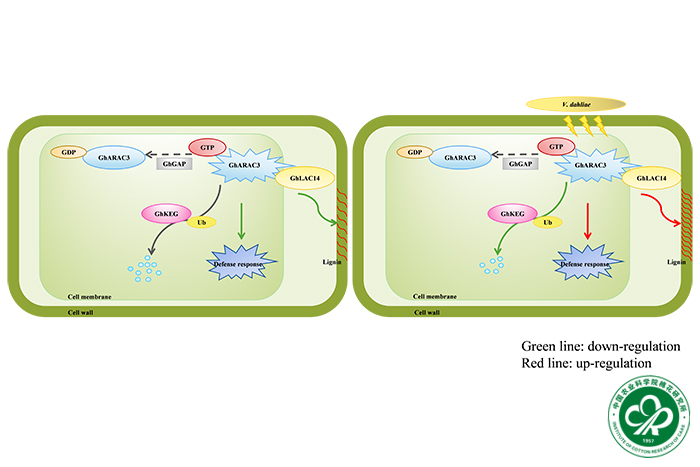
Through proteomic screening and genetic functional identification, the study found that the cotton small GTPase GhARAC3 is a key regulator of Verticillium wilt resistance, positively regulating resistance by integrating upstream E3 ligase-mediated ubiquitination and degradation with downstream laccase-dependent lignin deposition. Under normal physiological conditions, the E3 ubiquitin ligase GhKEG targets GhARAC3 and mediates its rapid degradation in the proteasome, effectively avoiding excessive immune expenditure when no pathogen threat exists.
When V. dahliae infects the plant, this ubiquitination degradation pathway is suppressed, leading to stable accumulation of GhARAC3 protein at the plasma membrane. Further study showed that GhARAC3 interacts at the plasma membrane with the transmembrane laccase GhLAC14 and significantly enhances laccase catalytic activity, driving efficient cross-linking and deposition of dense guaiacyl lignin in the cell wall. Transcriptome data also confirmed that GhARAC3 broadly activates the phenylpropanoid metabolism pathway at the transcriptional level, providing sufficient precursors for downstream lignin polymerization.
The study elucidates the molecular mechanism by which cotton achieves a rapid immune response by regulating the rate of protein degradation, providing a theoretical basis and potential targets for breeding cotton with improved disease resistance. The work was supported by the National Key R&D Program, the Tianshan Innovation Team project, the Natural Science Foundation of Xinjiang Uygur Autonomous Region, the Xinjiang "Tianchi Talent" recruitment program and the CAAS Science and Technology Innovation Project. CRI doctoral student Wu Yajie and assistant researcher Zhou Jinglong are co-first authors; researchers Feng Hongjie and Zhu Heqin are co-corresponding authors.