- Location : Home» Newsroom
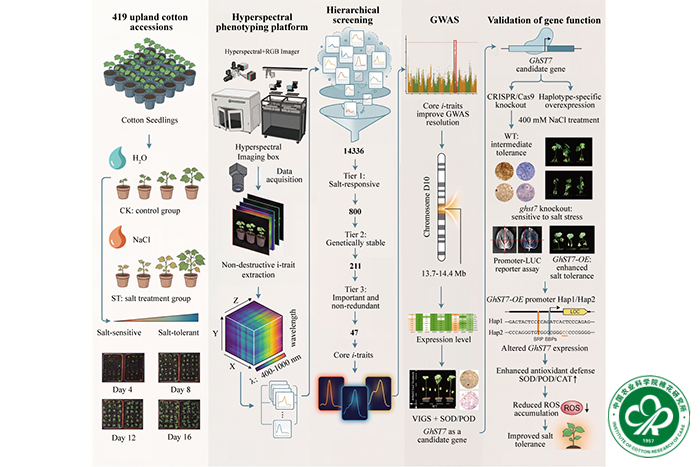
An integrated framework coupling hierarchical hyperspectral i-trait screening, gene identification, and functional validation for genetic dissection of salt tolerance in cotton
Soil salinization is a major abiotic stress limiting cotton yield and fiber quality. Salt tolerance in cotton is a complex quantitative trait governed by polygenes, which is difficult to dissect precisely using conventional manual phenotyping methods, owing to their low throughput, destructive sampling, and poor standardization. These limitations hinder the capture of subtle, dynamic salt-response signals at the seedling stage and slow the discovery of salt-tolerant genes for molecular breeding. Here, we developed an integrated hyperspectral imaging phenotyping pipeline for non-destructive, time-series imaging of a cotton natural population under salt and control conditions across four time points. A total of 14 336 image-derived features were extracted, and a three-tier hierarchical screening workflow for i-traits was established: biological relevance prioritization, genetic-effect filtering, and machine-learning-based redundancy reduction. Combining t-tests, heritability estimation and consensus machine learning, we retained 47 core salt-responsive i-traits with robust biological meaning, high heritability and low redundancy. Using GWAS on these optimized hyperspectral i-traits, we pinpointed a candidate salt-tolerance gene GhST7 on chromosome D10. Subsequent genetic and physiological assays validated the function of GhST7 in positively regulating cotton salt tolerance. This work establishes a high-throughput hyperspectral phenomics-genetics framework for dissecting complex abiotic stress traits, provides valuable gene resources for salt-tolerant cotton improvement, and offers a transferable strategy for stress-resistance molecular design breeding in crops.