- Location : Home» Newsroom
GhLBD18 triggers GhATG18a-dependent autophagy during somatic embryogenesis in cotton
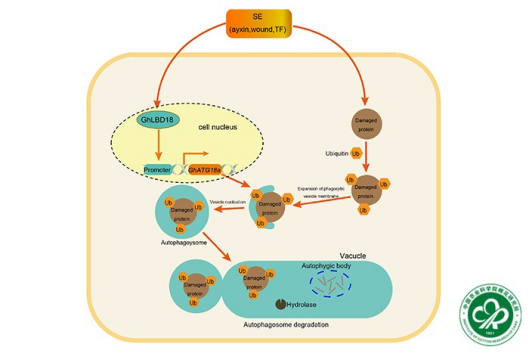
Introduction Autophagy is well established as a critical mechanism in plant stress responses and sexual reproduction, yet its molecular mechanisms during asexual reproduction remains poorly characterized. Deciphering the autophagy regulatory network in somatic embryogenesis (SE), a key model of asexual reproduction, holds substantial significance for advancing our understanding of plant cell totipotency and improving crop genetic transformation systems. Objectives This study aimed to identify and characterize key autophagy-related regulators in cotton asexual reproduction, and to elucidate their transcriptional regulatory network. Methods We performed transcriptome analysis across distinct ovule developmental stages in cotton, integrating subsequent molecular and cellular investigations. Functional characterization was conducted by generating overexpression lines coupled with comprehensive phenotypic and histological examinations. The molecular regulatory mechanism was elucidated using yeast one-hybrid assays (Y1H), electrophoretic mobility shift assays (EMSA), and dual-luciferase reporter assays. Autophagic activity at different SE stages was assessed by transmission electron microscopy (TEM), monodansylcadaverine (MDC) staining, and Western blot analysis. Results We identified GhATG18a as a potential autophagy-related regulator of somatic embryogenesis (SE), a model of plant asexual reproduction, based on transcriptome analyses across key SE developmental stages. Phenotypic characterization revealed that GhATG18a overexpression significantly enhanced callus formation and proliferation, accompanied by elevated autophagic activity throughout SE. Mechanistically, the transcription factor GhLBD18 directly binds the GhATG18a promoter and increases its transcriptional activity, thereby promoting callus formation and proliferation. These findings demonstrate that the GhLBD18-GhATG18a pathway accelerates early SE stages and shortens the transformation cycle by enhancing autophagy, providing a theoretical foundation for elucidating the role of autophagy in cell fate transitions and improving cotton genetic transformation systems.