- Location : Home» Newsroom
An investigation of the dual mechanism of uORF-mediated regulation of GGP1 expression and the effects on drought stress in cotton
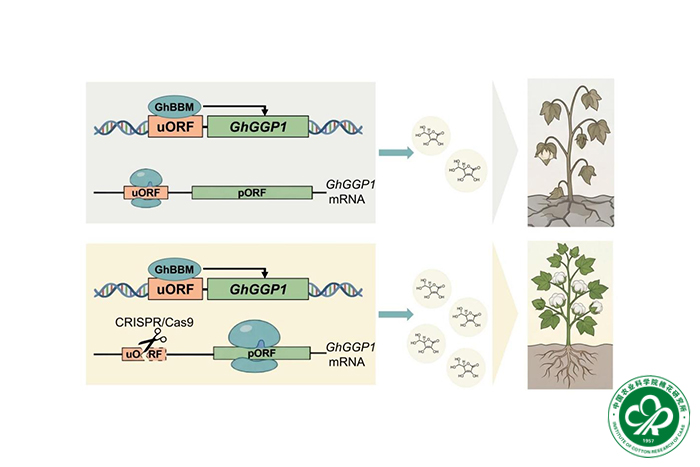
Upstream open reading frames (uORFs) are prevalent cis-regulatory elements in eukaryotic mRNAs, which participate in the fine-tuning of gene expression mainly at the translational level. However, how uORFs orchestrate transcriptional and translational regulation of target genes and modulate plant drought tolerance remains largely elusive in cotton. In this study, we identified two conserved uORFs within the 5′-untranslated region (5′-UTR) of cotton GGP1, a key gene involved in ascorbate biosynthesis. Genetic, ribosome profiling, dual-luciferase reporter and point-mutation assays revealed that these uORFs exert a dual regulatory mode: they not only repress GGP1 translation via ribosome stalling under normal conditions, but also participate in modulating the transcriptional abundance of GGP1. Under drought stress, the inhibitory effect of uORFs is partially relieved, permitting the elevation of GGP1 transcripts and protein accumulation. Elevated GGP1 activity increases endogenous ascorbic acid content, scavenges excess reactive oxygen species, maintains cell membrane integrity, and ultimately enhances drought resistance of cotton plants. Disruption of the uORF sequences released the repression of GGP1, leading to constitutively higher ascorbate levels and stronger drought tolerance. Our results uncover a previously unrecognized dual regulatory paradigm of uORFs acting at both transcription and translation layers, and provide a promising strategy for genetic improvement of drought tolerance in cotton.