- Location : Home» Newsroom
ICR‑CAAS Holds Special Lecture on the Spirit of Scientists
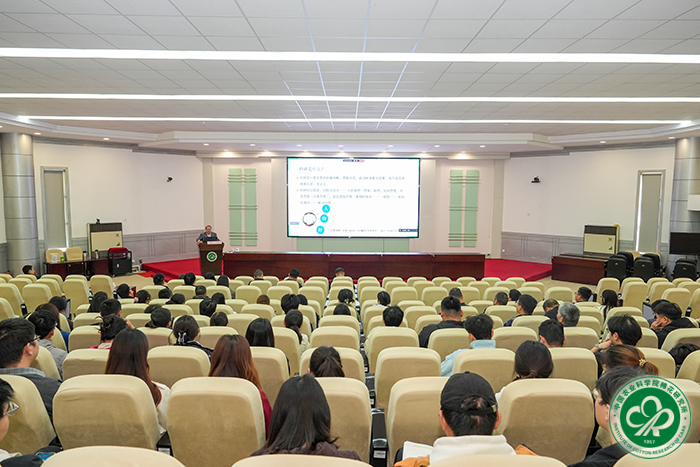
To promote the spirit of scientists in the new era and guide researchers and postgraduate students of the institute to foster a correct view of scientific research performance, the Institute of Cotton Research of the Chinese Academy of Agricultural Sciences (ICR‑CAAS) jointly organized a special lecture on the spirit of scientists on October 28, 2026. Co-organizers included the Cotton Professional Committee of the Chinese Society of Crop Sciences, the State Key Laboratory of Cotton Biological Breeding and Comprehensive Utilization, and the Key Laboratory of Cotton Biology and Genetic Breeding of the Ministry of Agriculture and Rural Affairs. Researcher Du Xiongming was invited to deliver the keynote report. Gao Lei, Director and Party Secretary of ICR‑CAAS, presided over the lecture.
Entitled “The Road of Scientific Research: Orientation, Thinking, Competence and Persistence”, Researcher Du Xiongming shared his insights into scientific research with practical cases from five perspectives: research topic selection, innovative thinking, competence development, the view of academic performance, and reflections on research. He stated that scientific research integrates value judgment, thinking patterns and comprehensive capabilities. It is a long‑distance race rather than a short sprint. Researchers need not only solid technical expertise, but also six core soft competencies: curiosity, perseverance, execution, critical thinking, methodological awareness and time management. Researchers should uphold a correct view of scientific research performance, abandon the paper‑only orientation, and stick to the bottom line of academic integrity. Research topics must closely follow the “Four Orientations”, target genuine industrial challenges, select appropriate research directions, and avoid blind pursuit of trendy research hotspots. Reverse thinking and interdisciplinary approaches should be adopted to pursue original innovation, break disciplinary boundaries, and explore scientific laws through cross‑field integration. At the end of the report, combined with the “ICR‑CAAS Spirit” and taking germplasm collection, identification and preservation as an example, he shared his four decades of research experience. He noted that diligent work and unwavering commitment underpin breakthroughs in tackling research bottlenecks, and continuous talent succession is the cornerstone of sustainable disciplinary development. His sharing offered valuable experience and profound inspiration to all attendees.
Gao Lei emphasized that the spirit of scientists represents precious spiritual wealth accumulated by researchers through long‑term scientific practice. At this critical stage of seed industry revitalization and achieving self‑reliance and self‑strength in cotton science and technology, all researchers, especially young scientists in the institute, should take veteran scientists as role models. They shall learn and reflect in the context of their own research, and integrate their personal academic pursuits into the overall development of the national cotton industry.
More than 200 participants, including institute researchers, postgraduate students and students from the Tarim University Cotton Class, attended the lecture via hybrid online and offline channels.