- Location : Home» Newsroom
Integrated multi-omics analysis to elucidate the genetic basis of seed traits in cotton
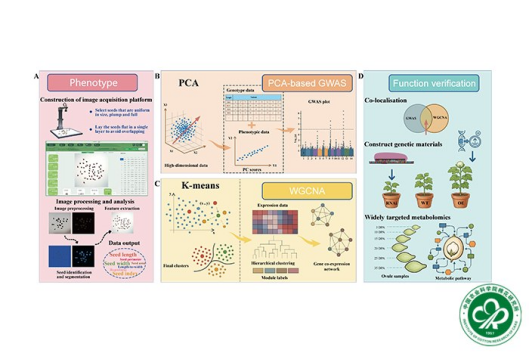
Introduction Seed size is a complex agronomic trait influencing seed germination, seedling vitality, and yield. The traditional single-omics strategy for identifying seed size-related genes has the disadvantage of low accuracy, limiting its potential application in molecular breeding. Objectives This study aimed to integrate multi-omics approaches to identify key genes and pathways regulating cotton seed size. Methods We employed 413 accessions of seeds from natural cotton populations to quantitatively obtain seed size-related phenotypes (length, width, area, roundness, perimeter, length-to-width ratio, and seed index) using phenomics technology. Dimensionality reduction was applied to seven phenotypic datasets to identify elements that can simultaneously map phenotypic traits. These were then combined with genomic data for genome-wide association studies (GWAS) to identify candidate genes. Representative accessions were screened by k-means clustering to construct differential gene expression profiles at different developmental stages, and a hub gene set was determined by WGCNA. Genes in QTL from GWAS and hub genes from WGCNA are co-localized to identify key genes, and gene functions are verified through genetic material construction and metabolomics analysis. Results The co-localization results from GWAS and transcriptomics efficiently and precisely identified a novel gene, GhCSS10. Constructed RNAi and overexpression transgenic lines confirmed their positive regulation of seed size. Metabolomics further demonstrated that variations in seed size are closely associated with metabolic processes, including cell energy activation, cell expansion, carbohydrate deposition, and seed filling. Conclusion The multi-omics integration strategy developed in this study effectively identifies key genes and metabolic pathways regulating cotton seed size. It provides a novel perspective for elucidating the molecular basis of cotton seed development and offers highly valuable targets for genetic improvement in cotton.