- Location : Home» Newsroom
Thiacloprid-Zn-sodium alginate-chitosan microcapsules for sustained Aphis gossypii control, alleviated plant chemical stress, and reduced non-target toxicity
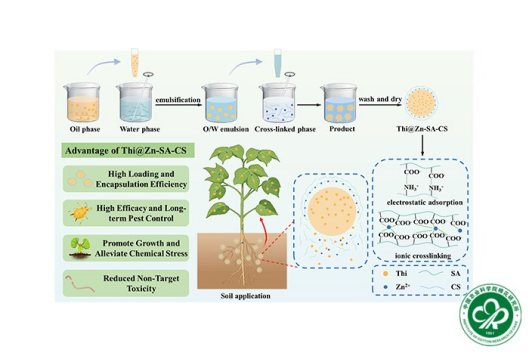
Neonicotinoid insecticides have been widely used in agriculture due to their broad insecticidal spectrum and high biological activity. However, the inefficiency of traditional pesticide formulations causes significant potential environmental risks. Microencapsulation technology is crucial in sustainable agriculture by enhancing bioactivity, extending duration, and reducing the impact on non-target organisms. In this study, Zn-sodium alginate-chitosan microcapsules loaded with thiacloprid (Thi@Zn-SA-CS) were prepared by emulsification-cross-linking method, using sodium alginate and chitosan as wall materials and Zn 2 + as crosslinking agent. Thi@Zn-SA-CS exhibited a loading of 61.50% and an encapsulation efficiency of 85.99%. The morphology and structure of Thi@Zn-SA-CS were characterized by scanning electron microscopy, Fourier transform infrared spectrum, and X-ray photoelectron spectroscopy. The pot experiments demonstrated that Thi@Zn-SA-CS exhibited superior control efficacy and longer duration against Aphis gossypii, and revealed the great potential of Zn-SA-CS as a high-efficiency zinc fertilizer for cotton. The biosafety assessment indicated that Thi@Zn-SA-CS had no adverse effects on cotton seed germination, alleviated thiacloprid-induced chemical stress on cotton plants, and reduced acute toxicity to earthworms. The results confirm that Thi@Zn-SA-CS can improve pesticide utilization, alleviate chemical stress, and reduce risks to non-target organisms. This study provides a viable approach for developing sustainable, environmentally friendly, and highly effective pesticide formulations.