- Location : Home» Newsroom
A practical event-based sampling protocol for fertigation-induced greenhouse gas fluxes in arid drip-irrigated cotton
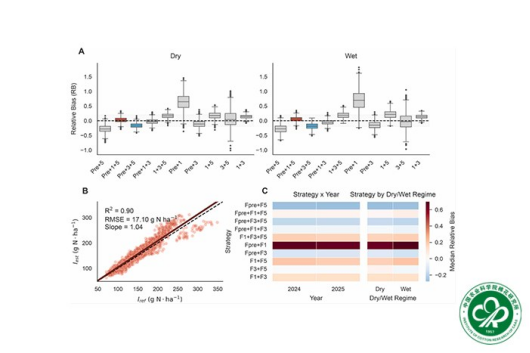
Fertigation in arid drip-irrigated cotton can produce transient greenhouse gas flux pulses that routine chamber sampling may miss. A practical schedule is needed to capture post-irrigation dynamics without excessive field and laboratory work. Using a two-season, multi-treatment dataset, we characterized N 2 O, CO 2 and CH 4 flux patterns and compared reduced schedules with a four-node manual-chamber benchmark. N 2 O and CO 2 showed early peak–decay patterns, with maximum fluxes 1 day after irrigation; CH 4 remained a diffusion-limited sink with a flatter response. Performance depended less on sample number than on whether key times were retained. Omitting day 1 increased integration bias. The three-node F pre + F 1 + F 5 schedule preserved the main pulse structure and achieved a 96.55% N 2 O success rate under the |RB= ≤ 0.20 criterion. The results support a targeted protocol including the pre-irrigation baseline, day-1 peak and day-5 tail, using the four-node integral as an operational benchmark rather than a substitute for continuous flux measurement. By linking sampling to scheduled irrigation and fertigation events, this protocol helps account for transient greenhouse gas flux pulses in water and nutrient management evaluations for arid cotton systems.