- Location : Home» Newsroom
Increasing negative impacts of high temperature on cotton production during the flowering and boll-setting in the context of global warming
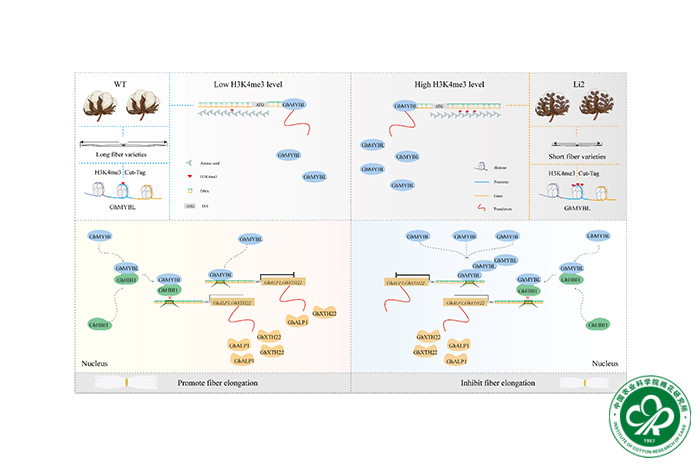
Histone modifications are central to plant development, yet how they coordinate cellular morphogenesis remains poorly understood. Cotton fibers, as single-celled trichomes derived from seed epidermal cells, provide an ideal model to address this question. We adopted multi-omics approaches including CUT&Tag for genome-wide H3K4me3 profiling and transcriptome sequencing, combined with multiple molecular and genetic validation assays: virus-induced gene silencing, overexpression, CRISPR/Cas9 editing, yeast one‑hybrid and two‑hybrid, electrophoretic mobility shift assay, co‑immunoprecipitation, and split-luciferase complementation. We identified GhMYBL as a core transcriptional repressor that negatively regulates fiber elongation. GhMYBL is under dual-layered control: H3K4me3 modification governs its transcriptional abundance, while GhHBI1 attenuates its DNA-binding activity at the post-translational level. GhMYBL directly represses two positive regulators GhXTH22 and GhALP1 to restrict fiber elongation; GhHBI1 alleviates this repression, permitting the normal expression of GhXTH22 and GhALP1 and synergistically promoting fiber cell elongation. Our findings demonstrate that divergent H3K4me3 signals orchestrate GhMYBL-dependent transcriptional repression, which is further fine-tuned via protein–protein interaction with GhHBI1 to coordinate single-cell fiber elongation. This work reveals the epigenetic regulatory mechanism underlying plant cell elongation and offers valuable target genes for genetic improvement of cotton fiber quality.